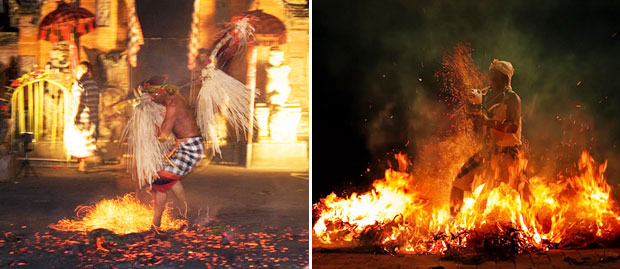
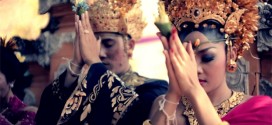
Balinese sacrad dance rituals, performed to ward off pestilence and plague, and restore harmony to the seen and unseen. Two young girls on their verge of puberty, often 8 to 10 years old, “pure” and old enough to be intermediaries with the spirits, don their dancing attire. The pemangku priest makes offerings to the deity of the temple requesting protection for the village during the trance ceremony. Behind the girls are seated a group of women who chant the sanghyang song, which ask the celestial nymph to the scend from heaven and dance before the people through the bodies of the girls Fragrant is the smoke of incense The smoke that coils and upward Toward the home of the three divine ones
Described here is Sanghyang Dedari, a ritual dance where it is believed a divine spirit temporarily descends to a village and reveals itself through the entranced dancers. Sanghyang is the title for a deified spirit and means “The Revered One” or “Holiness”; Dedari means “Angel”
With eyes closed, the girls rock back and forth above the incense until they fall down fullyintrance.The attending women putflowered crowns upon their heads and lift them to the shoulders of male Detainers who carry them to the place where they are to dance. Set upon the grouna between the female choir and male chorus, the little dancers sway listlessly in a dreamy version of the Legong. Their movements coincide automatically although their eyes never open during the entire performance. When the chanting ceases, girls fall to the ground in a swoon. They are brought out of trance by the pemangku, who prays beside them and blesses them with holy water.
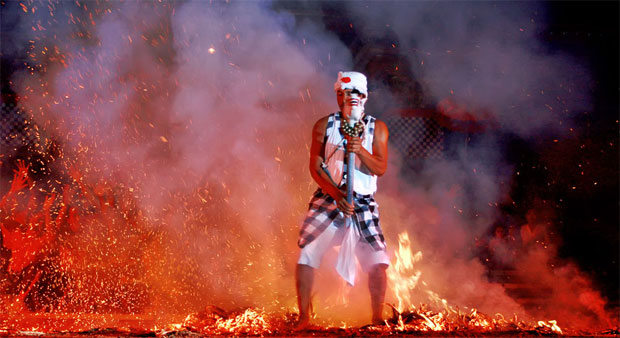
The girls dancing as “Revered Angels” are always underage, for a virgin child is considered holy.There are other forms of the Sanghyang trance dance as well. In Sanghyang Jaran, an entranced boy (or priest) dances on a horse, jaran, represented by a hobbyhorse. He dances around a bonfire made from coconut husks. If the Sanghyang song leads him, he dances through the fire. Mountain villages near Kintamani perform the Sanghyang Deling, where puppets dance suspended on a string between two poles manipulated by childrenSanghyang dances developed from the essential religious function of maintaining the health and well-being of the village. They are performed to exorcise evil spirits that may be infesting the community in the form of sickness or death. The boys and girls selected to be Sanghyang dancers are highly regarded bythe community and are exempt from certain village responsibilities. The feats they perform while dancing are accepted as a medium of spiritua expression, since the dancer is thought to be possessed by a deity. The Sanghyang Dedari dancers have never had any dancing lessons In normal life, they cannot remember nor repeat the motions they enact while in trance. Nor can a Sanghyang Jaran dancer normally walk on fire.
So intriguing to the island visitor, trance, as. an elevated state of consciousness, is part Balinese life and is viewed as quite natural by the people. An entranced person believed communicating with a divine presence is respected as holy and is left free to express himself under a directive influence, usually that of a priest,The Balinese are careful never to let one entranced get out of hand. There are always guardians from the village who stand by during a trance ceremony to exercise control should it be needed.

Thanks for the explanation!
Could you tell me please how can I see this dance?
When and where?